
Racalm App
Building a tool to track mood and to assist panic attack
Duration
12 weeks
Practices
Secondary research, survey and interview, Figma, Adobe XD, Adobe Illustration
Project Overview
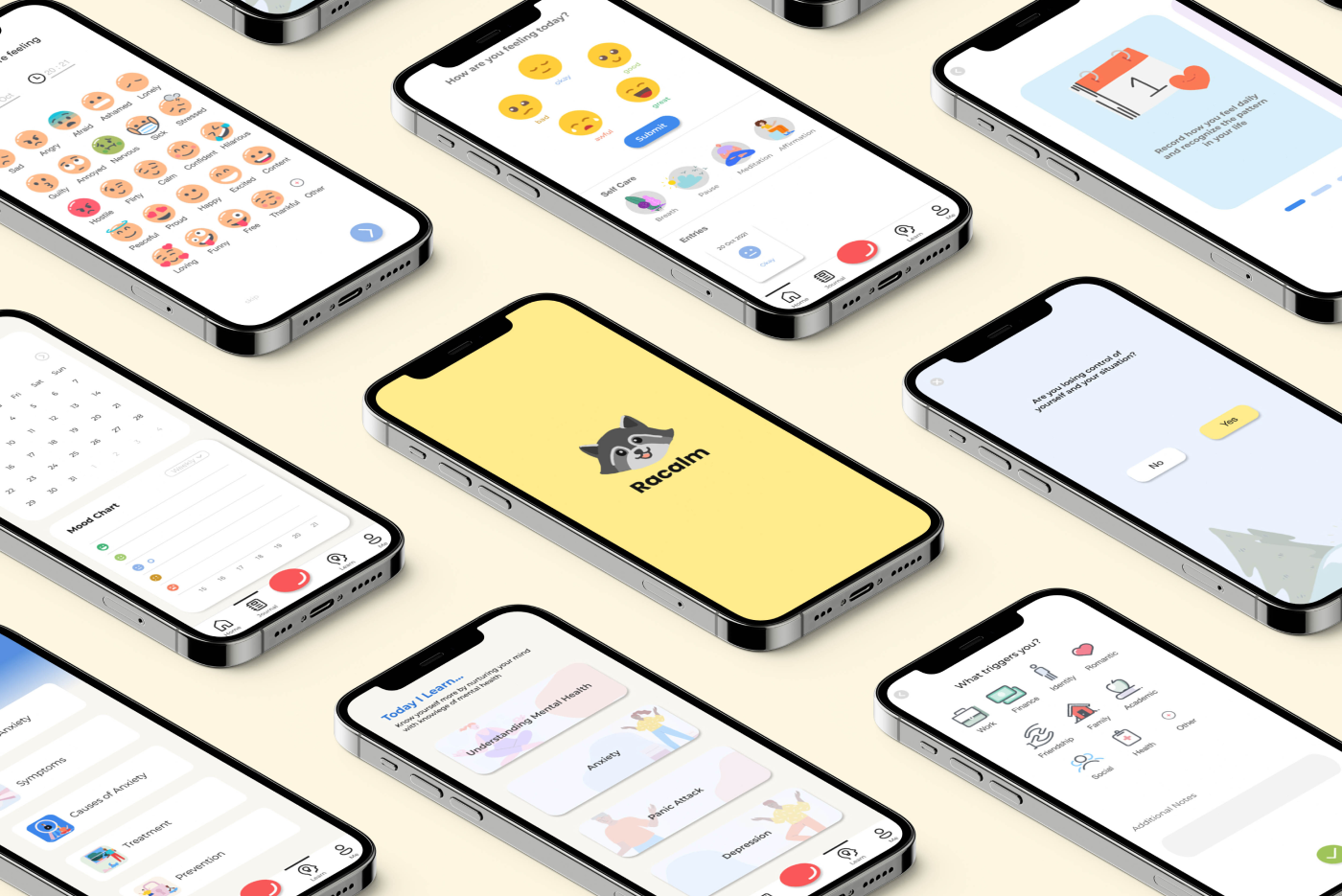
Racalm is a mobile app to help user tracking their daily mood in order to recognize pattern of their mental health and to give assistance during
panic attack situation.
This was created for personal project after gaining insights from 2 UX online courses I signed up : ‘Into UX Design’ by Anfisa Bogolomova and California Institute of the Arts. The projects started effectively in August 2021 after its 10-month hiatus since September 2020 in which I worked on the entire product creation process.
Challenges
Decision-making under distress
During panic attacks, people feel overwhelmed and report that thinking “shuts down,” leaving them unsure what to do.Reluctance to seek professional help
Many feel their situation isn’t “severe enough,” rely on friends/family (not always available), and delay care.Limited psycho-education
Adults juggle growing responsibilities without enough mental-health literacy—sleep issues, constant worry, and burnout signs go unmanaged.Ignoring early warning signs
Panic episodes often build from many triggers; without tools to notice trends, crises feel sudden and unmanageable.
My approach
Discovery Phase
Surveys & Interviews (18–40 y/o)
95% experienced anxiety/depression in the last 5 years; 45% reported panic attacks.
Only ~20% sought professional help.
Common triggers: work/academic load, then relationships.
Typical coping: talk to close contacts, keep busy.
Secondary Research
Australian stats indicate anxiety/depression are common (NHS 2017–18).
Decision-making literature: anxiety → threat avoidance; depression → reduced reward seeking and info gathering—affects how people interact with interfaces.
Inclusive design guidance (UK Home Office): give time, explain what happens next, let users review, make key info clear, and provide support.
Problem & Goals (synthesized)
People lack simple tools to learn patterns, underrate their symptoms, and can’t act decisively in panic. Racalm should help users track trends, prepare for triggers, and receive step-by-step aid during crises—complementing, not replacing, professional care.
2. Design and Development
Product Vision
A calm, simple, and intuitive app that:
surfaces patterns in mood and triggers,
provides guided assistance during panic/anxiety, and
offers learning and practice (mindfulness, education) to build resilience.
App Functions
Track & Journal moods/signals to recognize early warnings.
Panic Assistance with clear, stepwise guidance.
Learn & Train via psycho-education and exercises.
Target Users
People with panic attacks, anxiety, depression.
People seeking mindfulness/mental-fitness tools.
Mental-health practitioners and caretakers.
3. Testing and Iteration
Early probes via mini surveys/interviews shaped problem framing and feature set. As a solo project, I iterated in small loops—tightening language, simplifying flows, and stress-testing panic guidance for clarity. (Next phase: broaden testing with more diverse users, including vulnerable groups.)
Prototype
Future Plan
Continuous Improvement
Expand research participants; include vulnerable groups.
Add analytics (e.g., behaviors in panic flow) with strict consent and privacy.
Refine crisis scripts with clinician input; add escalation paths.
Expansion
Personalization of patterns/triggers.
Optional clinician & caregiver views.
More training modules (breathing, grounding, reframing).
Reflection
There are still a lot more to explore until Racalm is launch-worthy. The whole process of the development enable me to gain holistic view of the research and development process to build a mobile app. It requires great amount of self-motivation with the fact that although I was given insights by another member, most of the time I work by myself. Therefore, for the first personal project I am glad I work on something that I have big interest in, instead of picking what is trending in the market, so it motivates me to keep going. Earlier in my journey, I also oftentimes found myself lost in details and I learned not to sweat on little stuff that consumes too much of my time. As a learner, I accept the fact that I will make mistakes and that means I give room for improvement.
To expand my knowledge beyond the theories I gained from the courses, I studied many projects and portfolios and the process designer went through in order to get the idea how they deliver the project in real life. From this I learned that there are many outstanding projects and portfolios out there but keeping it authentic and honest with my style are also pivotal point without forgetting the subject matters on how to effectively convey the rationale and present the design structurally.